Blog post 2
In preparation for the next session, we decided to try and push them a
little bit further into SSS (sport specific skills) as in the need’s analysis
page, you can see we believed there were a few strivers within the group that needed a more challenging session.
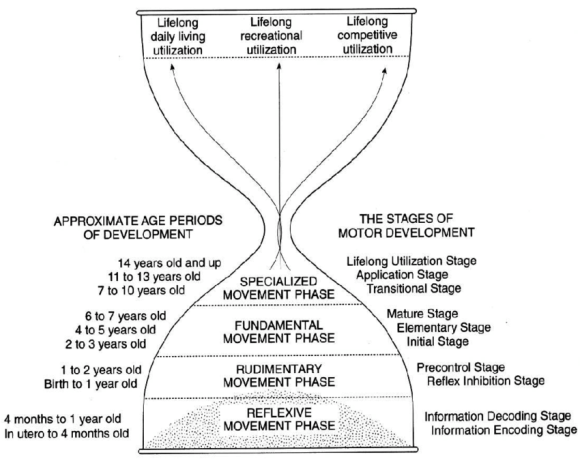
The learning objectives were revolved around simple basketball skills which included dribbling and different passing techniques. At this age group, we would expect to see that the majority of the group would be able to perform the basic skills, with a few of them being able to perform the skills in a technical drill scenario. We thought this because Gallehue and Ozmun’s Hourglass model states they should be in the transitional stage into the specialised movement phase.
To begin with we thought it was best to get them into pairs so they can have as much repetition as possible around passing to another person. (Kirk, 2012) Working in pairs or in groups is important as we want to try develop peer relationships at this age (Lloyd and Oliver, 2012).
The passing part of the session was working well, and we could see they were improving. We decided to add in a dribbling aspect to the drill which involved dribbling and then passing. We could instantly see that a large portion of the group were struggling with the dribbling aspect of the drill. We could see that they were not being successful with this as they weren’t completing any of the dribbling and kept losing the ball when trying to complete the skill.
An in-action response from us was that we just focused on the passing aspect of the drill. Trying to get high repetitions of each pass between pairs was essential whilst also focusing on the correct technique for both passing and catching. The reason that we did this is that we believed that it would be easier for the group to focus on one skill rather than do lots of new skills at the same time. After the session, I came away and found that doing this was correct as we didn’t want them to try remember too many things at the same time trying to perform the skills (Buchanan and Kock, 2001).
To get the high repetitions, we added in that we wanted to see who could get the highest number of passes without dropping the ball. On top of this, to let the strivers excel, we let them set their own challenge point to say they could stand as far away as they wanted, and if they still found it easy, we moved them backwards ourselves to create that challenge.
References
Buchanan J., Kock N. (2001) Information Overload: A Decision Making Perspective. In: Köksalan M., Zionts S. (eds) Multiple Criteria Decision Making in the New Millennium. Lecture Notes in Economics and Mathematical Systems, vol 507. Springer, Berlin, Heidelberg
Gallahue, D. L., Ozmun, J. C. and Goodway, J. (2012) Understanding motor development : infants, children, adolescents, adults. Seventh edition. McGraw-Hill Education.
Kirk, L. (2012) ‘Learning through Repetition’, Swimming World, 53(4), pp. 31–32.
Lloyd, R. S. and Oliver, J. L. (2012) ‘The Youth Physical Development Model: A New Approach to Long-Term Athletic Development’, Strength & Conditioning Journal (Lippincott Williams & Wilkins), 34(3), pp. 61–72.
 Callum Bruce - Coaching Context Placement Blog